

With time running out to secure the 30% federal tax credit for new solar projects, ForeFront Power helps clean energy buyers identify near-term opportunities to lock in lower electricity rates, source cost-competitive developer partners, future-proof contracts, and track submission deadlines.
The U.S. made sweeping changes to clean energy policy this summer through the enactment of the One Big Beautiful Bill Act (OBBB) and the release of new Treasury guidance on tax credit eligibility.
Clean energy tax credits, which have long supported solar and wind projects, will now phase out much sooner than previous deadlines established under the Inflation Reduction Act. To remain eligible for credits, developers now face shortened project timelines and new equipment restrictions tied to foreign entities.
As these changes take effect, it’s critical for clean energy buyers to understand the implications and act quickly to take advantage of remaining opportunities for full tax credits. Tax credits have been a cornerstone of solar project economics since the late 2000’s and are a key driver of project implementation. The federal tax credit covers 30% of project costs, reducing the upfront cost to buyers, and improving project ROI. The impending loss of this stable incentive will disrupt buyers’ ability to implement low-cost, clean energy ahead of an unprecedented run-up in electricity rates.
ForeFront Power is a full-service advisor with in-house interconnection, permitting, construction, project finance, tax, and procurement expertise closely monitoring all aspects of rules changes to give buyers confidence in their project timelines and anticipated savings. .
What Changed in the New Congress Legislation
OBBB, signed into law on July 4th, 2025, accelerates the phaseout of the section 48E Investment Tax Credit (ITC) and 48Y Production Tax Credit (PTC) and introduces new restrictions on “Foreign Entities of Concern” (FEOC). The Treasury released updated guidance shortly after, clarifying “beginning of construction” (BOC) rules for projects to safe harbor tax credits. The immediate result of these changes is that less renewable generation will be built and available for purchase, adding upward pressure to long-term power prices Wood Mackenzie predicts 17% solar fewer projects over 10 years, while Bloomberg NEF estimates 41% fewer clean energy projects after 2027 (PV Magazine) In addition, electricity prices are expected to increase across all states as demand outpaces new generation.
Tax Credits Phaseout
The accelerated phaseout of tax credits available to renewable projects is one of the most significant changes affecting clean energy development:
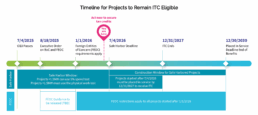
- Solar and wind projects must begin construction by July 4th, 2026, and be placed in service within four years to remain eligible for ITC/PTC.
- Projects that begin construction after July 4th, 2026, are still eligible for tax credits so long as they are placed in service by December 31st, 2027.
- Other eligible technologies—such as battery storage, nuclear, and geothermal—retain full credit value through 2033, stepping down gradually to phase out in 2036.
Buyers should focus on advancing solar projects ahead of the July 4th, 2026 deadline to retain full credit value—projects started after the July deadline will likely struggle to hit the compressed development timeline.
New “Foreign Entity of Concern” (FEOC) Restrictions:
Starting January 1st, 2026, projects with “material assistance” from Prohibited Foreign Entities (PFEs)—defined as China, Iran, North Korea, and Russia—will be ineligible for tax credits. Projects must demonstrate that at least 40% of direct costs (for solar) and 55% (for storage) come from non-PFE sources. Further guidance on FEOC requirements is still pending from Treasury, expected to be released later this year..
This could significantly affect procurement decisions, component availability, and project pricing as domestic supply chains are already facing capacity limitations.
New Treasury Guidance on Beginning of Construction (BOC):
Historically, developers and buyers of clean energy projects have been able to safe harbor tax credits in two ways, either by incurring 5% of project costs or by physically starting the project (the “physical work test”), to demonstrate beginning of construction. The new treasury guidelines implement project size restrictions on safe harboring:
- Projects > 1.5MWac can no longer use the 5% spend test and must rely on the physical work test, demonstrating meaningful on-site or off-site construction activity (e.g., foundations, racking, or manufacturing of project-specific components).
- Projects < 1.5MWac may still use the 5% spend test and can safe harbor full tax credits by incurring at least 5% of project costs, typically through equipment procurement.
Both small and large-scale projects must begin construction by July 4th, 2026, and must be placed in service within 4 years of BOC to meet continuity safe harbor guidelines. For corporate buyers, this makes it even more important to work with experienced developers who have safe-harbored equipment and can demonstrate compliant project progress.
What This Means for Clean Energy Buyers
The compressed development timelines and phaseout of tax credits create a narrow window for buyers to take action and lock in long-term electricity pricing at lower rates, before the most significant impacts of reduced generation buildout manifest in power bills. Buyers should focus on:
- Accelerating priority projects: Review timelines for approved or late-stage projects to ensure they remain eligible for tax credits. Locking in eligible projects now is the most effective way to de-risk portfolios and secure long-term savings.
- Diversifying solutions: To meet renewable and sustainability goals while managing risk, consider a mix of on-site and off-site solutions. Accelerating near-term on-site solar or storage can help hedge against rising power prices, while entering off-site PPAs can help secure long-term supply of renewable power.
- Monitoring policy and market developments: Stay closely aligned with developers, advisors, and internal stakeholders to anticipate regulatory shifts and move quickly when favorable opportunities arise.
How ForeFront Can Help
ForeFront Power’s renewable energy advisory team can help your organization:
- Review your portfolio for near-term opportunities to lock in long-term savings.
- Match projects with developers that have available capacity and competitive pricing.
- Protect your organization from development and price risk through smart contract structuring and review.
- Oversee project development to ensure project’s progress and are completed by the relevant deadlines.
The next year will be critical for buyers to secure projects and contracts under current incentives. Connect with ForeFront’s Advisory team today to develop a strategy to lock in savings before the July 4th, 2026, deadline.



Interested in learning more?
We would love to discuss how our solutions might be a fit for your organization.
Complete this form to if you would like one of our experts to reach out to you:
Our Headquarters is located at:
ForeFront Power
255 California Street, Suite 900
San Francisco, CA 94111